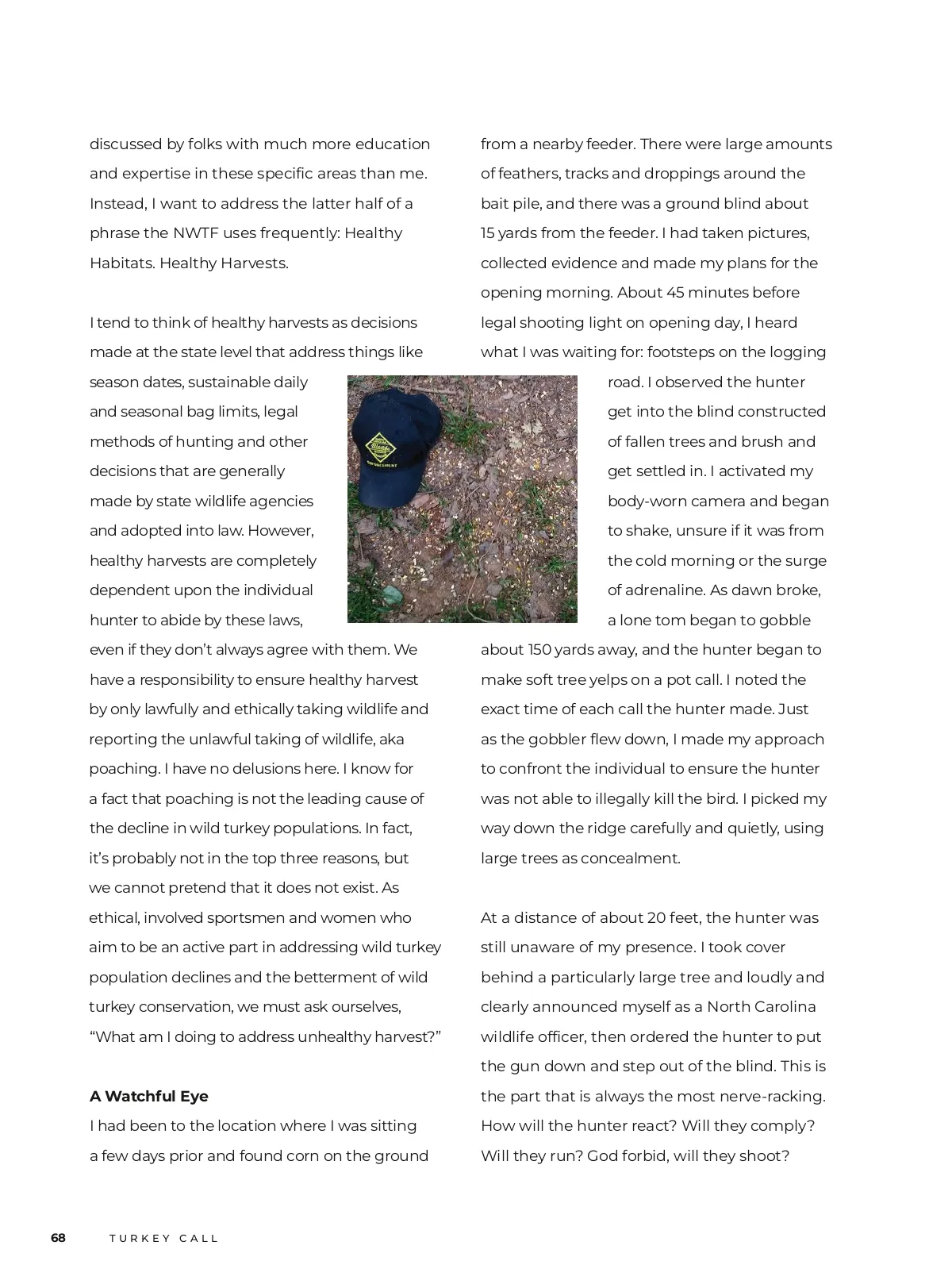
discussed by folks with much more education and expertise in these specific areas than me. Instead, I want to address the latter half of a phrase the NWTF uses frequently: Healthy Habitats. Healthy Harvests. from a nearby feeder. There were large amounts of feathers, tracks and droppings around the bait pile, and there was a ground blind about 15 yards from the feeder. I had taken pictures, collected evidence and made my plans for the opening morning. About 45 minutes before I tend to think of healthy harvests as decisions made at the state level that address things like season dates, sustainable daily and seasonal bag limits, legal methods of hunting and other decisions that are generally made by state wildlife agencies and adopted into law. However, healthy harvests are completely dependent upon the individual hunter to abide by these laws, even if they don’t always agree with them. We have a responsibility to ensure healthy harvest by only lawfully and ethically taking wildlife and reporting the unlawful taking of wildlife, aka poaching. I have no delusions here. I know for a fact that poaching is not the leading cause of the decline in wild turkey populations. In fact, it’s probably not in the top three reasons, but we cannot pretend that it does not exist. As ethical, involved sportsmen and women who aim to be an active part in addressing wild turkey population declines and the betterment of wild turkey conservation, we must ask ourselves, “What am I doing to address unhealthy harvest?” legal shooting light on opening day, I heard what I was waiting for: footsteps on the logging road. I observed the hunter get into the blind constructed of fallen trees and brush and get settled in. I activated my body-worn camera and began to shake, unsure if it was from the cold morning or the surge of adrenaline. As dawn broke, a lone tom began to gobble about 150 yards away, and the hunter began to make soft tree yelps on a pot call. I noted the exact time of each call the hunter made. Just as the gobbler flew down, I made my approach to confront the individual to ensure the hunter was not able to illegally kill the bird. I picked my way down the ridge carefully and quietly, using large trees as concealment. At a distance of about 20 feet, the hunter was still unaware of my presence. I took cover behind a particularly large tree and loudly and clearly announced myself as a North Carolina wildlife officer, then ordered the hunter to put the gun down and step out of the blind. This is A Watchful Eye I had been to the location where I was sitting a few days prior and found corn on the ground the part that is always the most nerve-racking. How will the hunter react? Will they comply? Will they run? God forbid, will they shoot? 68 TURKEY CALL
Turkey Call May/June 2023: Page 68